For a local service business, your website isn’t just an online business card. It’s the engine that turns interested locals into paying clients.
Think about how people search today: whether someone finds you through Google, sees a post on social media, or gets a recommendation from a neighbor, they almost always land on your site before deciding to reach out. But what happens after they arrive?
If your site is slow, confusing, or hides your phone number behind three sub-menus, visitors won’t stick around—they’ll click back to Google and call your competitor. A pretty website is useless if it doesn’t make it effortless for customers to get in touch.
If you want your website to actually bring in phone calls and quote requests, make sure it hits these five essentials.
1. Mobile-First “Click-to-Call” & Easy Contact Options
Picture a homeowner standing in their hallway with a leaking pipe or someone looking for a local service while sitting in their car between errands. They aren’t sitting at a desktop with a notepad—they are on a smartphone, and they want an answer fast.
On a small screen, every extra tap causes friction. If someone has to pinch-to-zoom, hunt through a drop-down menu, or manually copy a 10-digit phone number into their dialer, you’ve already lost them.
How to fix it:
-
Stick a click-to-call button at the top: Make sure your phone number is front and center on mobile, preferably pinned to the header so it follows the user as they scroll.
-
Keep forms short: Only ask for what you need to start the conversation—usually a name, phone number, and brief message. Long 10-field forms kill conversion rates.
-
Put contact buttons on every service page: Don’t make people navigate over to a separate “Contact Us” page just to ask a quick question.
2. Real Local Trust Signals (Not Just Generic Claims)
When prospective customers land on your site, they are asking themselves one main question: “Can I trust these people in my home or with my business?”
Saying you offer “great service” isn’t enough anymore. Anyone can write that. What actually moves the needle are specific, verifiable proof points that show you’re an established, honest business rooted in the local community.
What to show off:
-
Customer reviews right where decisions happen: Instead of hiding reviews on a buried “Testimonials” page, place short, powerful quote snippets right next to your contact forms and service descriptions.
-
Clear service areas: Explicitly list the specific towns, neighborhoods, or counties you serve so visitors know immediately if you cover their area.
-
Real photos: Ditch the generic corporate stock photos. Show real pictures of your team, company vehicles, or local projects.
3. A Clear Value Proposition “Above the Fold”
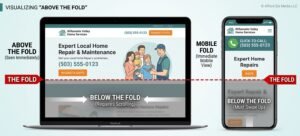
“Above the fold” simply means the top area of your homepage that visitors see before they start scrolling.
When someone lands on your site, you have about three seconds to answer three basic questions:
-
What service do you provide?
-
Where do you provide it?
-
What should they do next?
Avoid overly clever slogans that sound neat but say nothing. If your headline reads “Bringing Excellence to Your Doorstep,” nobody knows if you’re a carpet cleaner, an electrician, or a pizza delivery driver.
A simple layout that works:
-
Headline: Plain language statement of what you do (e.g., Reliable Residential Plumbing in Salem & Surrounding Areas).
-
Subheadline: One line explaining why customers choose you (e.g., Fast response times, upfront pricing, and 24/7 emergency service.).
-
Call to Action: A clear primary button (e.g., Call Now or Request a Free Quote).
4. Solid Local SEO Foundations
Getting traffic to your site in the first place requires showing search engines exactly where you operate and what you do. Local SEO isn’t something you slap on after a site is finished—it’s built right into the structure of your pages.
Key elements to check:
-
NAP Consistency: Your Name, Address, and Phone number should match everywhere on your site—and match your Google Business Profile exactly.
-
Dedicated Service Pages: If you offer three main services, create a clear, dedicated page for each one rather than cramming everything onto one long page.
-
Schema / Structured Data: Behind-the-scenes code that helps Google read your business hours, address, reviews, and service category directly.
5. Fast Speed and Secure Hosting
Site speed is a huge part of user experience. If a page takes more than a couple of seconds to load on a mobile phone, visitors simply bounce back to search results. On top of that, Google uses site speed as a ranking factor for local search.
Security is just as vital. If a browser displays a warning saying “Not Secure” at the top of your URL bar, potential clients will close the tab immediately out of caution.
Quick performance checklist:
-
Compress your images: Large, unoptimized image files are the #1 culprit behind slow mobile sites.
-
Use clean, secure hosting: Ensure your SSL certificate (HTTPS) is active and up to date.
-
Test on real phones: Don’t just look at your site on a high-speed desktop connection—test it on a mobile network to see how fast it loads in the real world.
Ready to Turn Your Website Into a Lead Generator?
Your website should be your hardest-working salesperson. When you combine clear messaging, mobile click-to-call options, local trust signals, and fast performance, your site stops being just a cost and starts generating steady local leads.
At Afford Six Media LLC, we help local business owners optimize their online presence so they get found online and turn site traffic into real phone calls.
If you’re not sure how your current site measures up, get in touch with us today for a straightforward local website and marketing evaluation.